A Note of Gratitude to Steve Scafidi

Recently I received something pretty unusual: a kind of “fan email” for my limited-edition chapbook, White-Feathered Bodies. It was from a guy I’d never met, Steve Scafidi. I told my publishers at Q Ave about it, and learned just what a gifted poet Scafidi is. You should check out this collection at Blackbird, featuring poems like “On the Occasion of an Argument Beside the River Where I Live,” and “The Hayfield Chandelier” along with an audio interview and a reading.  Or check out this discussion of “How a Poem Happens,” analyzing “To Whoever Set My Truck on Fire.”

What an unusual and generous thing! I think it says something about Steve. A passion? That someone can feel like Emily Dickinson’s description of how she knows she’s read a poem (the top of her head feels like it comes off)? A humility? That someone (fellow writer or not) would take a moment and try to communicate that experience, as a word of encouragement to the writer? For me, Scafidi’s email was generous and unexpected. And it came, I don’t know, a year after that small book was released? Or was it that I’d been on a run of rejections? A few weeks later when I was setting up this blog and posting reviews and summaries of a few books, I decided to include Scafidi’s comment along with the original blurb on the book by Rick Jackson.

A few weeks later, he said he’d seen what he’d written to me, and wished I’d have at least let him know that I was using his email as a blurb. Fair enough. I wondered, Why did I use a quote he’d sent to me as a private email in such a public way as to include it on my blogsite as if it had been written publicly? I was in a hurry, I guess. At the very least I certainly should have given thought to promoting my own work with Scafidi’s email comment. It would have been more polite–more appropriate–to have simply asked him if it would be all right to use what he’d sent me on my blog. So, here, publicly, thank you Steve for taking the time to look me up and send me a good word!

Tagged , , ,

Mission Accomplished? A First Draft

It’s printing as I write. Simon Krimple’s Wager. The first time I’ve printed any of it as a matter of fact. A first draft. 100,000 words later and mission accomplished! 325 double-spaced pages. A first complete draft. Wow. Feels pretty good. A signpost in the sometimes seemingly endless terrain of novel writing.

A first draft is a special animal. For me, the goal this time around was to get it down. Beginning, middle, and end as I’d often tell my students when we’d do a writing exercise. Get something down all the way through. All the way through being the key phrase. In this way, you can justify keeping up with brick-and-mortar things like meeting a daily and weekly goal for word count. You get into the zone when you can, but sometimes you slog forward with prose you know probably won’t make the cut later on. Maybe it’s not the wisest approach. After all, words are words. You can fall in love with sheer quantity, patting yourself on the back for producing some certain amount of words that very well may suck. It certainly isn’t a “best words, best order” approach. But that’s for the craft drafts, right?

I won’t name my goal, and actually the word count itself is less important than the main goal, which was to produce a “complete” first draft in 12-16 weeks, depending of course on where the narrative took me. But I did chart my daily progress. It helped with accountability, too. If I’m counting correctly, this first draft took 20 weeks (but there were a good three in there over the no-school holidays where very little got done and there was a week in Disney), so technically I feel like I was only about a week off in meeting my goal.

Mission accomplished? Well, let’s say I hope it isn’t the equivalent of standing on an aircraft carrier three weeks into the Iraq War and saying the same thing. But I do know there’s a way to go yet. Layers of editing, arranging. In short, the craft. Poet Tom Lux says he loves all the in-between drafts. The first is scariest. Just getting it down. The later drafts of fine tuning can get wearying. The in-between drafts are where so much of the excitement and artistry get done. I believe novelist Richard Russo, who takes about four years for each novel, says something similar.

Perhaps I shouldn’t tell Shelley that part about four years? Yikes, it’s still printing!

Tagged , , , ,

Finding Inspiration: Bob Dylan

A few weeks ago, Shelley got us tickets to go see the Avett Brothers at Track 29 here in Chattanooga. I discovered the Avett Brothers two or three years back, and had actually them introduced them to her. She’s a folkie through and through when it comes to music. For some reason, I’ve never taken to the Avett Brothers in the way that I expected to, but Shelley’s been off the rails for them–and the concert only served to inflame her passion. In fact, she became so excited about them that she actually told me that she’d like for me to start playing the guitar again (singing, not so much), but guitar, yes. Now, I’d been in a band (One Shoe Untied) with my brother and a few other amigos up until this past year when I finally got my chance to work full-time at being a writer and running C&R Press. Being in a band, too? That wasn’t going to cut it. I understood. Plus, the band, as bands are 99.9% of the time, was trouble.

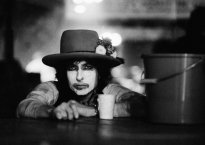
I hadn’t played a lick in nearly a year when Shelley said, “I think you should start playing the guitar again.” My wife was actually telling me to play the guitar, not just tolerating it? She’s also started practicing the piano again herself and is working on John Lennon’s “Imagine.” I decided I better go ahead and see how I felt about this myself. I tuned up my guitars and started remembering all I’ve forgotten over the past year. Then, voila, as if in synchronicity the bi-monthly issue of my American Songwriter magazine came in the mail, and it was none other than a tribute to Bob Dylan, celebrating his 70th birthday. In fact, you can check out their site and see that even as we speak they’re celebrating 30 days of Dylan. Funny, but the opening of one of the Dylan articles begins with the latest Grammies in which Mumford and Sons and The Avett Brothers opened for Dylan as a kind of “passing of the torch” to the new generation of folk-inspired songwriting. According to the article, Dylan performed an enigmatic rendition of “Maggie’s Farm” which was as much to suggest the extended reaches of the possibilities of creative performance as anything else. It contrasted quite a bit with the earnest, conservative approaches of the former bands, and the writer suggests that Dylan was playing “keep away with the torch” more than he was passing it on.

I don’t know. I do know that Dylan represents a lot of things to a lot of people, some of it misguided, some of it head-scratching, but, in the end, he can’t be ignored in the annals of American songwriting (he prefers simply to call himself a performer). In fact, this is what Mason Jennings writes about him:

Bob Dylan is an invention. That’s important to remember. That persona is as much or more a work of art as his songs are. I saw him a few years ago. I remember standing with the soundman when a fan came running back at him and started screaming “Fix this! What’s he doing? I paid so much money! Fix it!” before storming out. The rest of the crowd was on their feet loving it. The person Bob Dylan is still dividing crowds 50 years later. No small feat. I have no idea what Robert Zimmerman is like but one thing is for sure, he is an inventor on the ranks for DaVinci and Tesla, and a visionary on the ranks of Steve Jobs and Walt Disney. Can’t imagine our world without him. It’d be a completely different place.

The complete Paul Zollo Interview, which took place in 1991, was published in this latest American Songwriter issue and it does offer some insight into Dylan’s ever-mysterious processes, as well as some interesting opinions about who the really great songwriters are. He says things like Hank Williams is probably the greatest songwriter ever (and then concedes that it may be a tie with Woodie Guthrie, both of whom he then asserts were performers and not just songwriters). He says there are more than enough songs to go around for the rest of time, that the world doesn’t need any more songs.

So, how is this inspiring? Well, besides what’s already been mentioned, for me it starts with sheer endurance. Here’s another example (see Woody Allen below) of a guy who, despite a large set of very real limitations is, well, legendary. He’s basically a poet who puts his music to simple melodies, and his voice…ah yes his voice. Well, let’s say this. Of course, it’s rough and grizzled and occasionally incomprehensible these days. But for whatever you want to say about his tone (or lack thereof), the dude hasn’t been doing this for 5 decades running because he can’t hold a note. He can, and he does. Take it from one who knows THAT part of the singing limitation blues.

Tagged , ,

Finding Inspiration: Woody Allen

Last night, Shelley and I found a pleasant evening of escape watching Woody Allen’s much-anticipated Midnight in Paris. In fact, we’d already tried to go to the movie while it was in theaters both in Denver and in Chattanooga and through a series of near-misses still hadn’t seen it when it had long since come out on DVD. It was worth the wait. For one, it was a little uncanny how much the character, Gil Pender, played by Owen Wilson resembled me. Maybe there was some over identification, too, but the fact that he was a novelist falling completely in love with Paris (where he’d never been before), a bit on the introverted side, not wanting to stay out late to go dance with his fiance and her friends, and then falling into a fantasy of living in the 1920s (after the bell tolls midnight of course) were all aspects I could in one way or another relate to. Also, one of the main themes that the novel explores is overtly nostalgia (Gil Pender’s main protagonist owns a nostalgia shop), C&R did just publish Mickey Hess’s The Nostalgia Echo!

Anyway, I would venture to say that overall this film is a highlight in the great Allen’s ouevre. Although it doesn’t have the depth of other Allen classics, it certainly has enough humor and creative energy to satisfy this Allen fan. And the inspiration of this post is really more about Woody Allen as a writer, creator, performer than it is about Midnight in Paris anyway. I recently saw a documentary on how Allen rose to fame, the struggles he went through in the Village in the late 1960s in New York, his terrible fear of working in front of live audiences as a performer, his lucky break in getting into film (and the terms under which he insisted he work), and his casual and open-ended directorial style, which gives loads of creative freedom (even down to the very lines he’s written for them) to the actors themselves. Hard to believe this guy is in his late 70s and still producing about a film a year. I recall in the documentary he said that he really never looks back. Whether a film falls flat on its face or bears a degree of success, he is already moving forward on the next project and rarely takes time to look back. There’s a secret to artistic meaning in there somewhere, whether or not that particularly makes a promoter happy.

But what “struck” me last night as the bell tolled midnight and suddenly there was Gil Pender surrounded by Ernest Hemingway, the Fitzgeralds, T.S. Eliot, Gertrude Stein, Pablo Picasso, Salvador Dali and many other “1920 Paris notables,” was the creative freedom Allen must feel. The very idea that we’d skip from a standard romantic comedy to a kind of fabulist romantic, Cinderalla-esque parallel story takes a kind of creative freedom–whatever age you are. I admire his sense of play. It seems like Allen has a clear sense of balance as a serious artist–one that doesn’t feel the need to take himself too seriously.

I just finished an in-depth interview with Bob Dylan in the latest American Songwriter magazine, and found similar inspiration from another 1960s-birthed American, artistic icon for similar reasons. Stay tuned. In the meantime, keep on entering the wild world of the creative imagination and don’t be afraid to play around (words to myself as much as anyone).

Tagged , ,

The Map and the Territory: ‘Death of the Author’ Renewed

In graduate school one of the most stimulating and inspiring courses I took was Randy Malamud’s 20th Century British Fiction course, which he sub-titled, The Death of the Author. We began with Daniel Defoe’s Robinson Crusoe, ran on to J.M. Coetzee’s Foe, and other similarly “postmodern” wonders like Julian Barnes’ Flaubert’s Parrot, A.S. Byatt’s Possession, Michael Cunningham’s The Hours (after reading Virginia Woolf’s Mrs. Dalloway), and others. Each of these 20th/21st century writers has riffed on the possibilities of this ‘death of the author’ trope and of course so have many others. I wouldn’t say that Michel Houellebecq’s latest novel has “the death of the author” as a primary theme per se, but it certainly does seem to fall in the range of his sensibilities as a satirist. Also, upon a little examination of this controversial French author, it would seem that he believes the literary establishment has already made a caricature out of him, and that they don’t really read his books any more because they’ve already made up their minds about him. It’s an interesting point at which to first learn about the controversial author. My general impressions of The Map and the Territory are that this is a writer who doesn’t follow convention (he doesn’t mind (1) wandering off on philosophic or satirical tangents and (2) seems to care about plot movement only in the latter third of the novel when, again, he employs a detective style approach which seems as much to satirize the genre as anything, and (3) only develops character inasmuch as it might serve to titillate larger social purposes–or perhaps none at all), and that he doesn’t write what one would call an elegant prose. Houellebecq’s prose seems to fall more precisely into the journalistic. The novel also deals extensively with art and art-as-commodity–thus, with consumerism in general–and the apparent arbitrariness how something is valued and exported. He also develops a motif of the person who is withdrawn, unaware of “happiness” as a concept, and yet is somehow at least content. Definitely ideas that an American audience should at least consider as antidote to the one-sided mentality of happiness as a commodity in itself.

While I wouldn’t say it was my favorite style or approach, it certainly is a worthwhile experience, especially for an American reader. There aren’t many novels written quite like this from American novelists, and his “French cynicism” isn’t entirely without “redemption.” In fact, I find that his ability to summarize categories of people, or historical movements with the sweep of a single sentence refreshing in the sense that any satire which is accurate, however disappointing or sad the perception may be. Some have classified him in the vein of a Voltaire, a Baudelaire, or a Marquis de Sade. Of those three, I find The Map and the Territory to fall most closely to Voltaire.

Tagged , , ,

New Hope for the Dead Alive and Kicking

You know, when a book of “uncollected” work is published from someone who died well over a decade ago (technically, in another century), it’s safe to say that few to none are paying attention. That may be a safe enough assertion about any book, whether or not the author was primarily a poet. I’m writing this to say: Even if you are not primarily a poet, and even if you’re not already familiar with William Matthews, this book is a rich resource.

I met the co-editor, Sebastian Matthews, in the fall of 2006 at the Meacham Writers’ Workshop, a gathering of writers here in Chattanooga that William Matthews himself was a part of, originated by Richard Jackson in 1986. Regardless of our relationship and my admiration both of his father’s work, and also of Sebastian’s, I didn’t honestly expect this “Uncollected Matthews” to be all that “great.” What I mean is, my expectation, as I assume most readers’ would be, was that I was about to read some leftovers, a hodgepodge collection of what wasn’t previously good enough for one of the late great’s collected–and living–efforts. I was wrong. Now, to be clear, I am not the Matthews aficionado that many are, and a little under a year ago, Ron Slate wrote a review for New Hope for the Dead which seems incisive, broadly knowledgeable about Matthews’ work collectively, and he comes to the conclusion that the poetry (40 poems chosen from 200) is not quite as powerful as his other focused collections.

My approach here is to simply suggest that this book does offer a broader appeal than may initially meet the eye. While New Hope for the Dead does, in fact, feature a hodgepodge of various genres: poems, stories, essays (with a sprinkling of recipes at the end), reviews, letters, interviews, miscellany, and an afterword, I have to say that, like an airplane, it is more than the sum of its parts. I suppose I probably agree with Slate that the stories section is the least remarkable, although I disagree that the letters are of “questionable value.” More on that in a moment. Other than the poems, which I think comprise a remarkable collection in and of themselves, the most rewarding parts of this book for me have been reading the essays and reviews sections, followed closely by the letters. The essays feature some helpful insights into Richard Hugo’s work, a thoughtful exegesis of Emily Dickinson’s #987, as well as a wonderful discussion about the effective, necessary and appropriate use of satire (with its ensuing parallels between then and now), as well as how Martial was ironically used by other poets in history, in “Martial’s Darts.” “Martial’s enemies ought to be everyone’s–hypocrisy, emotional stinginess, gaud, sanctimony, prigs and dullards,” the essay begins. For whatever the precise reasons for a lack of critical (or meaningful) commentary–of reviews on poetics–there is a noticeable absence of it, and has been for many years now, which is why a short piece “On Reviewing” is as helpful as it is. The beginning offers us broad perspective:

The life of American poetry is too often obscured by such essentially sociological distractions as grants, anthologies, most reviews, teaching jobs, etc. All of these enterprises contribute to the literary climate, to be sure, but usually in the ways that matter least; too, these are enterprises that have traditionally proven equally distracting to writers whether they are well or poorly administered. The envy and competitiveness these distractions encourage are more often fed than opposed by local poetry sccenes and by most small magazines and little presses. In the midst of such distractions, one way to care for your share of the literary climate is to sit down with some poems, read them as intelligently and passionately as they and your own limits as a reader will allow, and to describe accurately to yourself you affections for and distrusts of those poems….To do this in public is to write a review.

He goes on to say that there is too much “automatic praising in our reviewing” and that we ought to take our craft more seriously and contribute to our field by way of this public discourse.

Finally, the letters from Matthews to Russell Banks, Daniel Halpern, and Stanley Plumly offer a deeper insight into the “self-conscious, skilled, and controlled” William Matthews, known also for his “erudition and wit,” but who in these letters is “candid and self-revealing,” sometimes a little insecure. With Sebastian’s own analysis of the letters–coupled by his examination of a photo of the four of them, which opens the section–and spanning the 70s, 80s, and 90s, the letters open a door into the “life” of the writer, and also of certain aspects of the poetry community and literary life in general during that time. In all, I find New Hope for the Dead offers a rich tapestry of skill, erudition and wit, which could work as well in the collection of a young writer, as for the Matthews aficionado.

Tagged , , ,

Writing as Recovering

My parents, usually led by my dad, a minister, went through long periods of time when the family gathered for a devotion first thing in the morning around the table. One bleary-eyed morning, a reading from Genesis 32 stood out, probably because the events seemed to come out of the dream-like state I was still in, the famous Jacob-wrestling-an-angel passage. Actually, at first the account says he wrestles a man, and only later says it was God. Jacob goes down the river to get some water and next thing you know he’s wrestling with a “man” until daybreak. Then, and this was a part my adolescent mind struggled over, when the man realizes he’s not going to prevail against Jacob he touches Jacob’s hip socket and puts it out of socket. But Jacob still won’t let go until the man gives him a blessing. As William Goyen points out in his incredible essay on the subject, “Recovering,” the subduer actually asks for the blessing of the subdued. The man never tells Jacob his name, but he does give him a blessing and then Jacob goes on to name the place Peniel, which means The Face of God. As in, he’d wrestled with God face to face and received a blessing and a limp.

I think the reason this surreal scene stands out as such strong literature, and is so frequently used as an illustration for all sorts of difficult experiences–not the least of which is as a direct metaphor for writers of literature–is because of its profound, paradoxical metaphor of the “wound-that-heals” motif. My experience in working through a first draft of Simon Krimple’s Wager (what “counts” as my second novel) has been a similar struggle of recovering. While a great deal of the novel is completely “a work of the imagination,” there is also a fair portion that I draw on from my own life, some of which were pretty difficult times. For those writers who write “for themselves,” which I usually take to mean out of their own sense of aesthetic mission or purpose and not out of a direct appeal to market-driven forces, I think this sense of the struggle is especially true.

The word “recover” itself is fantastic for its layers of meaning. In the transitive verb sense it can, among other things, mean (1) to get back; regain; (2) to restore oneself to a normal state; (3) to bring under observation again. In the intransitive verb sense it can mean (1) to regain a normal or usual condition; (2) to receive a favorable judgment. Reginald Gibbons opens a biographical essay on the subject of “recovering” and writing with the illustration of digging up a coffee can he’d buried years before with artifacts from his past inside. The act of writing, especially going back and “borrowing” from our own experiences, is very much like literally unearthing a part of ourselves and re-examining it in a new light.

There are plenty of days when the whole “literary pursuit” feels like a banging up against an impervious wall. What’s the point? Who will read this? Will anyone even make a dime from all this labor? Who am I writing for? How will any of this change anyone? So, the challenge is in the struggle itself; a struggle with the formless material you’re trying to shape into something of lasting value, the material that in some sense is “other” and in another sense is “self.” You have to keep venturing out into the darkness ahead and hoping to find some light. You have to keep believing that somehow you’ll arrive at a better self at the end of the project, even if that’s not the entire point of the struggle. Or is it?

Tagged , , ,

My Daughter’s Middle Finger

This is either (1) my daughter Lennyn’s response to every agent or publisher who doesn’t see the possibilities of her daddy’s first novel, OR (2) my daughter, Lennyn, telling her daddy which finger hurts. Today, I had to stop everything I was doing, and run to pick her up from preschool because she woke up with throw up all over her. They said she might have gastro-something-itis, and that she might be throwing up all day. When she got home she plopped in front of Curious George, pounded a cupful of grape juice and broke into a candy stash. She’s one tough chic.

Stumbling upon The Song of Lunch

How often do you flip on the TV and immediately start watching a film based on a poem? Let’s take it a step further: How often do you flip on the TV and immediately find yourself watching a compelling film based on a poem? For me, I can safely say that up until about four weeks ago, when it happened, this had never happened. In fact, come to think of it, I’m not sure how many films, short or otherwise (I think this one is only about 30 minutes), are based on poems. What makes it even more impressive is that the script for the film is virtually word for word from the poem itself.

Now, pick yourself up off the floor.

The poet, Christopher Reid (b. 1949), is something of a celebrity in London. Okay celebrity’s not the right word, but let’s just say he’s not exactly the unknown he is here stateside. He’s actually earned himself a solid reputation (if little critical attention anywhere) as one who publishes with the most elite of poetry publishers, Faber and Faber (where T.S. Eliot once held reign as poetry editor). All of this is rather inconsequential, however, to this truly wonderful book (and film!). Reid says it was inspired by an episode from Joyce’s Ulysses. You’ll have to excuse the movie trailer looking image of the front cover, but I suppose it is another anomaly to have a book of poems featuring two rather famous movie stars on its cover. It also helps that Alan Rickman and Emma Thompson are perfectly cast. This is what the PBS synopsis says:

When a middling copy editor/failed poet meets his former lover for lunch 15 years after their affair, he finds that everything — and nothing — has changed. From the tablecloths to the wine to his former lover, wealth and success now gloss the surface where kitsch and passion once held sway. He is bitter, petulant and increasingly inebriated; she is glamorous, generous, and eventually provoked. A dramatization of Christopher Reid’s acclaimed narrative poem, The Song of Lunch stars Alan Rickman (Harry Potter films) and Emma Thompson (Sense and Sensibility, film version) in the unnamed roles of He and She. Waiter, I’ll take the nostalgia special with a side of recrimination and finish with regret, for a lunch that celebrates love and ambition with poignancy, humor, and affection.

I found myself pulled in to the unexpected and “poetic-sounding” monologue, and to the highly-observant and sensuous imagery (imagery in the precise meaning of the word, as connoting all five senses). My first complete novel, The Director of Happiness, that takes place in an hour was inspired by a the contemporary novelist Nicholson Baker’s The Mezzanine. As I wrote it, I also re-examined some major 20th century classics that experimented with new ways of writing the novel (Ulysses, In Search of Lost Time, St. Petersburg, Mrs. Dalloway, The Metamorphosis). In this case, I could immediately tell that a lot was “happening” in the speaker’s mind even though very little was actually moving forward in plot time. When the book arrived, I literally could not put it down. Fantastic stuff that shows us the versatility of poetry, and what it can be.

Tagged , ,

Another Freak for the Fire

Jamie Iredell’s second full-length collection of genre-defying acrobatics (the title of his first, for instance, is Prose. Poems. A Novel) is a compendium of freakish behavior. Like a dictionary, the entries are arranged alphabetically and each entry features a “freak” definition. The purpose for the book is spelled out on page 55, under the entry, “Front Matter.”

This Book was written for one purpose and one purpose only: So that readers will become aware of, and respect the existence of, FREAKS in the reader’s everyday experience. The compilers and editor have no illusions about this book being used a reference tool. They expect you to use this book, make love on top of it when it’s been left on your bed and forgotten in the passionate sweep of general missives to the floor at such times, and they expect you will often spill your beer upon it. After you have learned about FREAKS, you can throw this book away…

All of which is a bolder undertaking than meets the eye (as the “compilers” note in the entry FREAKS) because if you’re going to be talking about “Freaks,” which is–as one may have already suspected–basically everyone, how do you so without ostracizing and/or offending? Ah. This is but part of the essential genius of Iredell’s voice. Importantly, you use humor, and the book is hilarious. In pieces like “Pet Sitting” and “Eagle Scout” and “Boobs” and “Thick Hair” and “White People,” the humor is literally Laugh Out Loud funny. In most cases, however, Iredell’s humor is a satirical blend of coarseness and philosophical high-mindedness. Which is another important necessary characteristic for such an enterprise: Don’t be afraid to offend–and when you do, at least slay them with the truth. It all comes together in a compressed volume that, in spite of its lack of narrative and apparent self-effacing quality (see above), invites re-reading and, like a favorite album (for those of us who remember such things), grows on you with each new sitting.

I will also add that The Book of Freaks has an original approach on the convention of self-reference. It upends the “conventions” of an Index, Dedication page, First Title Page, Second Title Page, Blurbs and other aspects of a book, for instance, by alphabetizing everything. To me, the suggestion is (or I could say “the way the form meets the subject” if I were feeling especially scholarly), nothing is above (or immune to) the satirical eye of Iredell, the “compiler” of all things freakish, including the creation of this thing called “literature” itself.

Tagged , ,
Follow

Get every new post delivered to your Inbox.